Budgeting for Installation, Calibration, and Long-Term Maintenance
1. Build the Full Environmental Testing Equipment Budget
A useful budget separates one-time costs from recurring costs. This method prevents low purchase prices from hiding high operating expenses.
One-time costs
Equipment purchase price.
Freight, insurance, customs, and unloading.
Site preparation, floor reinforcement, doors, ventilation, and drainage.
Electrical installation and network connection.
Factory acceptance testing and site acceptance testing.
Installation, commissioning, and operator training.
Recurring costs
Calibration and measurement verification.
Preventive maintenance and cleaning.
Electricity, water, compressed air, and cooling water.
Replacement filters, lamps, sensors, seals, batteries, and refrigerant-related parts.
Software updates, data storage, and compliance records.
Emergency service and production downtime.
| Cost category | Typical planning range | When it is paid | Main cost driver |
|---|---|---|---|
| Installation | 5 to 15 percent of equipment price | Before commissioning | Equipment size and site condition |
| Calibration | 1 to 3 percent per year | Every 6 or 12 months | Number of sensors and test points |
| Preventive maintenance | 1 to 4 percent per year | Quarterly or annually | Operating hours and system complexity |
| Utilities | 2 to 8 percent per year | Monthly | Temperature range and cycle time |
| Contingency | 5 to 10 percent per year | As needed | Age, workload, and spare part lead time |
2. Estimate Installation Costs Before Delivery
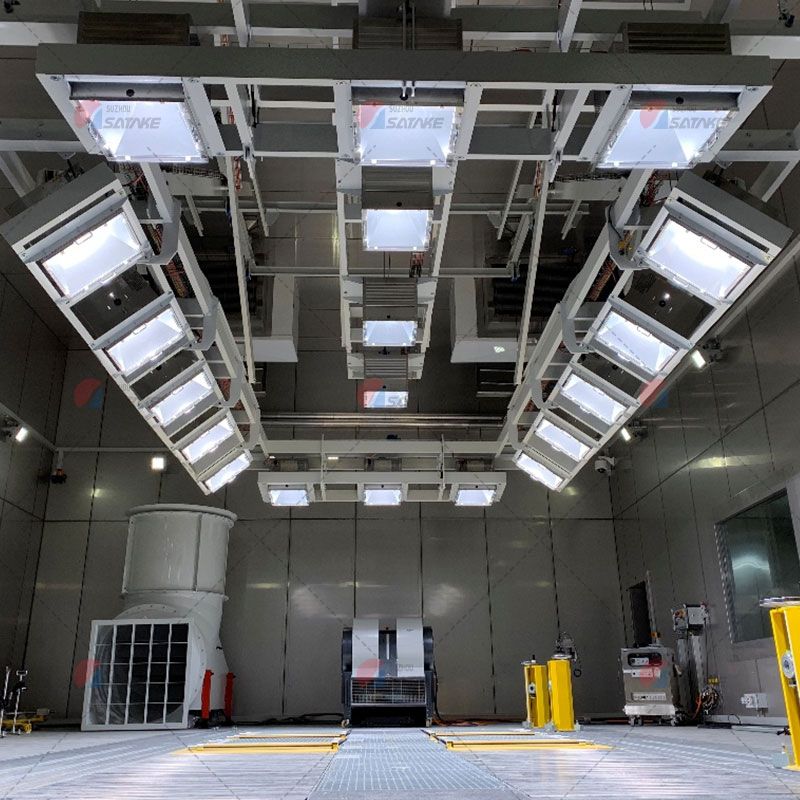
Installation costs depend on the chamber design and the building. A small bench-top chamber may need only a dedicated electrical outlet. A walk-in environmental test chamber may need structural changes, a larger door, floor reinforcement, drainage, and a dedicated cooling system.
Companies such as SATAKE show why application knowledge matters. A supplier should match the chamber size, temperature range, humidity range, vibration load, and test standard to the product under test.
Check the site requirements
Ask the Environmental Testing Equipment Manufacturer for a site preparation drawing before signing the purchase order. Confirm the following measurements:
Available door width and ceiling height.
Equipment footprint and service clearance.
Floor load capacity in kilograms per square meter.
Power supply, phase, voltage, and maximum current.
Room temperature and ventilation capacity.
Water supply, drainage, and compressed air requirements.
Network access for data export and remote diagnostics.
Example of a site installation budget
| Item | Planning amount | Budget note |
|---|---|---|
| Unloading and positioning | USD 800 to USD 3,000 | Depends on weight, floor level, and lifting equipment |
| Electrical work | USD 500 to USD 4,000 | Includes breaker, cable, outlet, and inspection |
| Ventilation or cooling | USD 1,000 to USD 8,000 | Important for high-temperature or high-load operation |
| Drainage and water treatment | USD 300 to USD 2,500 | Required for humidification systems in some facilities |
| Commissioning and training | USD 1,000 to USD 5,000 | Depends on equipment type and training hours |
These figures are planning ranges, not fixed quotations. A supplier should provide a site-specific estimate after reviewing the building, shipping route, and local labor rates.
3. Plan Calibration and Measurement Verification
Calibration confirms whether the instruments show the correct value within an approved tolerance. It does not repair a chamber or improve its performance by itself. The test system must also be checked for uniformity, stability, recovery time, and control accuracy.
Common calibration points
Temperature sensors at low, middle, and high set points.
Relative humidity sensors at several humidity levels.
Pressure sensors in altitude or pressure test systems.
Acceleration sensors in vibration test systems.
Light intensity sensors in ultraviolet weathering equipment.
Door safety switches, alarm circuits, and data recording channels.
For example, a chamber rated from minus 70 C to plus 150 C may be calibrated at minus 40 C, 23 C, and 120 C. A humidity chamber may use 30 percent, 50 percent, and 85 percent relative humidity. The actual points should match the customer test method.
Standards and traceability
Many laboratories use ISO/IEC 17025 as the quality framework for calibration competence. Environmental tests may refer to IEC 60068, ASTM methods, MIL-STD-810, or customer-specific procedures. The purchase specification should state which standard applies.
Request a calibration certificate that lists the reference instrument serial number, uncertainty, test points, environmental conditions, correction values, and traceability statement. A certificate without these details may not support an audit or product claim.
| Service | Typical interval | Typical duration | Budget factor |
|---|---|---|---|
| Temperature calibration | 6 to 12 months | 4 to 8 hours | Number of sensors and test points |
| Humidity calibration | 6 to 12 months | 6 to 10 hours | Humidity range and stabilization time |
| Uniformity survey | 12 months | 1 to 2 days | Chamber volume and data channels |
| Vibration calibration | 12 months | 4 to 8 hours | Frequency range and acceleration level |
| Safety inspection | 12 months | 2 to 4 hours | Equipment risk level and local rules |
4. Budget for Preventive Maintenance
Preventive maintenance reduces sudden failures. It also protects repeatability in temperature cycling tests, humidity tests, thermal shock tests, and accelerated aging tests.
Recommended maintenance tasks
Inspect door gaskets, latches, hinges, and viewing windows.
Clean the chamber interior, water tank, drain, and humidifier.
Clean condenser coils and replace air filters.
Check refrigerant system performance and abnormal noise.
Inspect wiring, terminals, relays, fuses, and grounding.
Test alarms, emergency stops, over-temperature protection, and door interlocks.
Back up programs, test records, and controller settings.
Review temperature and humidity trends for drift.
Maintenance cost by operating level
| Operating level | Annual operating hours | Recommended service | Maintenance reserve |
|---|---|---|---|
| Light use | Less than 2,000 hours | Annual inspection and calibration | 2 to 4 percent of purchase price |
| Normal use | 2,000 to 5,000 hours | Six-month inspection and annual calibration | 4 to 7 percent of purchase price |
| Heavy use | More than 5,000 hours | Quarterly inspection and six-month calibration | 7 to 12 percent of purchase price |
High humidity operation, frequent door opening, rapid temperature changes, and dusty rooms increase service needs. A preventive maintenance contract may cost more each year, but it can reduce emergency labor and production losses.
5. Use a Five-Year Total Cost of Ownership Model
The purchase price does not show the complete financial impact. A five-year total cost of ownership model makes different suppliers easier to compare.
Basic calculation
Five-year total cost equals purchase price plus installation, five years of calibration, five years of maintenance, five years of utilities, spare parts, training, and expected downtime.
For example, assume an environmental test chamber costs USD 50,000. Installation costs USD 6,000. Calibration costs USD 1,500 each year. Planned maintenance costs USD 2,000 each year. Utilities cost USD 3,000 each year. A five-year contingency reserve is USD 7,500.
| Five-year cost item | Example amount |
|---|---|
| Equipment purchase | USD 50,000 |
| Installation and commissioning | USD 6,000 |
| Calibration | USD 7,500 |
| Preventive maintenance | USD 10,000 |
| Utilities | USD 15,000 |
| Contingency and spare parts | USD 7,500 |
| Estimated five-year total | USD 96,000 |
In this example, the purchase price represents about 52 percent of the five-year cost. The remaining 48 percent comes from ownership and operation. This is why a low initial quotation may not be the lowest-cost choice.
6. Follow a Clear Installation and Service Workflow
A written workflow helps the buyer, supplier, contractor, and laboratory team complete each task in the correct order.
Step-by-step flow chart
| Define test method and product requirements | Confirm chamber size, range, load, and standards |
|---|
| Request site layout and utility data | Inspect floor, doors, power, ventilation, and drainage |
|---|
| Approve quotation and five-year cost plan | Deliver, unload, position, and connect equipment |
|---|
| Complete factory and site acceptance tests | Calibrate sensors and verify uniformity |
|---|
Train operators and release standard procedures | Schedule preventive maintenance and annual review
Acceptance checks after installation
Confirm the chamber reaches the specified temperature range.
Check humidity control at agreed set points.
Measure temperature uniformity at several locations.
Record recovery time after a defined door opening.
Test alarms, interlocks, emergency stop, and data logging.
Compare results with the purchase specification and test standard.
For a large chamber, a customer may require a nine-point or fifteen-point mapping survey. The supplier should state the sensor count, stabilization time, acceptance tolerance, and report format before testing begins.
7. Reduce Long-Term Maintenance and Downtime Costs
Good operating habits can lower maintenance demand. Operators should avoid overloading the chamber, blocking airflow, opening the door during extreme cycles, or placing wet products near electrical parts.
Practical cost control methods
Buy common replacement filters, gaskets, and fuses during the warranty period.
Keep a minimum stock of critical parts with lead times longer than 30 days.
Train at least two operators to prevent dependence on one employee.
Use data logging to identify temperature drift before a test fails.
Group calibration and maintenance visits to reduce travel costs.
Ask for remote diagnostic support when the controller permits secure access.
Compare repair cost with replacement cost when equipment is more than 10 years old.
Measure maintenance performance
Track mean time between failures, mean time to repair, calibration failures, repeat tests, and service response time. A useful target is to keep planned maintenance completion above 95 percent and calibration completion at 100 percent before any regulated test begins.
If one failed chamber test causes USD 2,000 in labor and material loss, preventing five failed tests can save USD 10,000. Include this avoided cost when comparing service contracts.
8. Compare Service Contracts and Supplier Support
Not every laboratory needs a full service contract. The correct choice depends on equipment value, test volume, internal skills, and the effect of downtime.
| Support option | Best for | Coverage | Budget impact |
|---|---|---|---|
| On-demand service | Low-use equipment | Repair when a problem occurs | Lower fixed cost, higher emergency risk |
| Preventive maintenance contract | Normal laboratory use | Scheduled inspection and service | Predictable annual cost |
| Full coverage contract | High-value production testing | Maintenance, labor, and selected parts | Higher fee, lower downtime risk |
| In-house maintenance | Large laboratories with trained staff | Daily checks and basic repairs | Requires tools, training, and spare parts |
Questions to ask an Environmental Testing Equipment Manufacturer
What is the standard warranty period?
What parts are excluded from the warranty?
How many service engineers are available in the target region?
What is the normal response time for a critical failure?
Are calibration certificates traceable to national or international standards?
How long will controllers, sensors, and software remain supported?
Can the supplier provide installation records, wiring diagrams, and service manuals?
What training is included, and how many operators can attend?
Conclusion
Budgeting for installation, calibration, and long-term maintenance requires more than comparing equipment prices. Include site preparation, utilities, calibration, preventive maintenance, spare parts, training, service response, and downtime. A five-year total cost of ownership model provides a clearer decision.
The right Environmental Testing Equipment Manufacturer should provide technical specifications, installation requirements, calibration plans, acceptance criteria, and service costs in writing. With this information, your laboratory can protect test accuracy, meet standards such as IEC 60068 and ISO/IEC 17025, and operate its equipment with fewer unexpected expenses.

评论
发表评论